Livno
Livno
Stone, wind, people, and the discipline of open space
Livno - a walk through history
Livno’s story begins long before the town itself had a name. The vast sweep of Livanjsko Polje, one of the largest karst fields in Europe, has drawn people for thousands of years. Traces of Neolithic and Bronze Age life can still be sensed in the landscape, in ancient burial mounds and in the way settlements naturally gravitated toward water and higher ground. Even in deep prehistory, this was a place shaped by movement and rootedness at once, where seasonal herding and farming set rhythms that echo, in altered form, to this day.
When the Illyrians inhabited the region and later when it became part of the Roman province of Dalmatia, Livno sat along routes that connected the interior of Bosnia with the Adriatic coast. Roman roads, villas, and scattered artifacts suggest a landscape tied to agriculture, trade, and military presence. After the fall of Rome, Byzantine influence lingered in fortified sites and early Christian structures, leaving another subtle layer in the region’s identity.
In the 7th century, with the arrival of the Slavs, Livno entered a new historical phase. It became part of a shifting frontier between the early Croatian lands to the west, the medieval Bosnian state to the north and east, and the Dalmatian coast to the south. During this time, Livno slowly grew from a primarily rural landscape into a recognizable local center. Christianization, especially in the Latin tradition, gradually shaped communal life, while pastoralism remained the backbone of existence.
By the high and late Middle Ages, Livno was firmly within the orbit of the Bosnian Kingdom, and later influenced by the powerful Kosača family in the south. This period left one of the most visible marks on the region: the stećci, medieval tombstones that today form part of a UNESCO World Heritage ensemble. Scattered across hills and open fields, they speak of a distinctive Bosnian medieval culture that understood death and memory as inseparable from the landscape itself.
The arrival of the Ottomans in the late 15th century transformed Livno once again. The town took on a new urban character, with mosques, caravan routes, markets, and inns weaving it into a wider Balkan network that linked Sarajevo, Mostar, and the coast. Religious communities lived side by side, sometimes tensely, often pragmatically, shaping a tradition of coexistence that would define Livno for centuries. At the same time, Livanjsko Polje continued to sustain large-scale herding, strengthening the pastoral economy and giving rise to what Livno is still best known for today: Livanjski sir and high-quality lamb.
When Austro-Hungary took control in 1878, Livno stepped into a more modern administrative and infrastructural world. Roads were improved, schools opened, and new architectural styles appeared alongside older Ottoman structures. The Franciscan Monastery on Gorica gained renewed prominence as both a spiritual and cultural center, anchoring Livno between its medieval roots and its modern future.
The 20th century brought upheaval, first through the formation of Yugoslavia and later through the war of the 1990s. Livno remained largely rural and economically modest, but culturally resilient. The war altered demographics and deepened divisions, yet memories of shared life and intertwined histories persisted beneath the surface.
Today, Livno’s identity is inseparable from its landscape. Livanjsko Polje, which shifts from green pasture to winter lake, shapes how people think about time, work, and endurance. Pastoral traditions remain strong, visible in cheese-making, seasonal grazing, and deep knowledge of the land. The town itself carries layers of Catholic, Orthodox, and Ottoman heritage, while nearby stećci remind visitors that this is a place where history is not confined to museums but embedded in the earth.
Livno stands at a threshold between coast and interior, between Bosnia and Dalmatia, between mountain and plain. It is a frontier in the best sense of the word a place shaped by movement, adaptation, and encounter. More than a town, Livno is a living cultural landscape, where every stone, river, and pasture tells part of a long, intricate story.
UNESCO context: Stećci and the medieval landscape
Livno occupies an important place within the UNESCO World Heritage Site “Stećci – Medieval Tombstone Graveyards”, inscribed in 2016. Several necropolises in the wider Livno area form part of this serial, transnational listing shared by Bosnia and Herzegovina, Croatia, Serbia, and Montenegro.
Dating from the 12th to the 16th century, these massive limestone tombstones are carved with crosses, rosettes, circles, hunting scenes, and stylized human figures. In the Livno region, stećci are inseparable from their setting - placed in open fields, pastures, and gentle slopes. Here, UNESCO recognition does not isolate monuments; it recognizes a cultural landscape, where memory, land, and movement are inseparable.
Livno people: shaped by landscape
Livno people are shaped by this openness. There is a reserve to Livnjaci that can feel distant at first, but it is not coldness - it is measured trust. Words are chosen carefully. Promises are not given lightly. Once given, they tend to hold.
Historically rooted in pastoral life, Livno developed a culture of self-reliance and quiet competence. Pride exists, but it is understated. Boasting is frowned upon; steadiness is admired. Humor is dry and precise, often arriving late. Hospitality is practical rather than performative - food appears without fuss, help without announcement.
This temperament explains the people Livno produces. Artists, thinkers, athletes, and innovators connected to Livno - from Gabrijel Jurkić and Ivan Goran Kovačić, to Zlatko Dalić and Mate Rimac - share a pattern: discipline over display, substance over spectacle. Livno does not produce loud ambassadors of identity. It produces people who leave, succeed, and remain internally connected to where they came from.
Cultural anchors and attractions
the heart of the town stands the Franciscan Monastery of Gorica, Livno’s cultural anchor. Its museum tells the long story of the region, from prehistoric finds in Livanjsko Polje to Roman, medieval, Ottoman, and Austro-Hungarian layers. The view from the monastery opens across the vast field below, offering the best introduction to Livno’s scale and character.
Above the town rise the remains of Livno Old Town. The fortress itself is simple, but its position is powerful. From here, the sweep of Livanjsko Polje becomes clear, especially at sunset, when light moves slowly across pasture, water, and distant mountains.
Just outside town, the spring of Duman reveals the hidden workings of the karst. The river Bistrica bursts from underground, cold and clear, reminding visitors how deeply water shapes this landscape. Walking along the spring and old mill sites is both peaceful and revealing.
Beyond the town stretches Livanjsko Polje, one of Europe’s largest karst fields. In spring and summer it is a sea of green pasture dotted with sheep and cattle. In winter it can become a shallow lake that attracts birds from across the region. Roads and paths along its edge invite slow drives, long walks, and quiet observation.
Livno’s identity is rooted in its pastoral tradition. Local life has long been tied to seasonal grazing, cheese-making, and working with a demanding landscape. Livanjski sir, made from sheep’s milk, is one of the region’s most distinctive products, alongside lamb, cured meats, and homemade bread. Visiting small producers and tasting their food offers a direct connection to this living tradition.
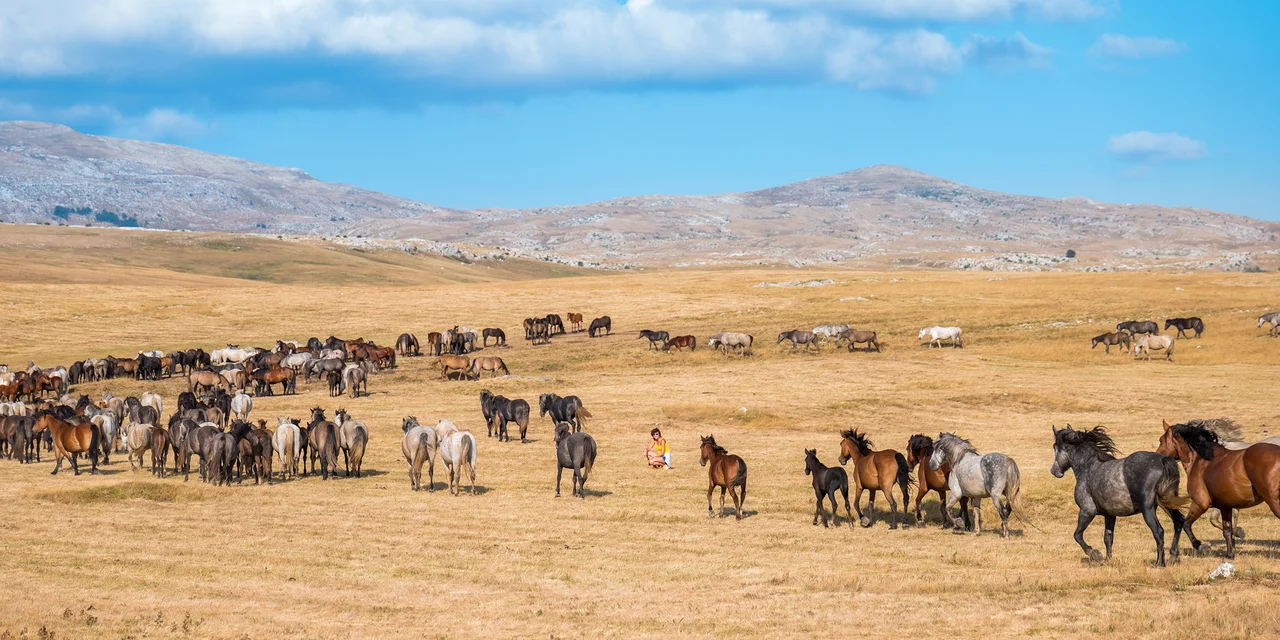
A short drive from town leads to the Cincár plateau, where open grasslands stretch beneath wide skies. Wild horses roam here, best observed calmly and from a respectful distance. The plateau offers sweeping views toward Livanjsko Polje and the Dinara mountains, and short walks that feel timeless.
The wider Livno area is also rich in stećci, medieval tombstones that form part of a UNESCO World Heritage site. Scattered across hills and open fields, they reflect a distinctive medieval culture that placed memory within the landscape itself. These sites are best visited quietly, with time to look and reflect.
To the north, toward Konjic, Jablanica, and Prozor, the landscape changes again. Forested mountains, clear air, and serene lakes create a different side of Livno, ideal for hiking, photography, and village exploration.
Livno is a place that rewards attention, its beauty lies in wide spaces, clear water, layered history, and the warmth of everyday life. Whether you come for nature, heritage, food, or simply silence, Livno leaves a lasting impression.
Livno in Two Days
An experience of space, culture, and perspective
Begin at the Franciscan Monastery at Gorica. Walk the grounds to understand Livno’s scale, then visit the museum to gain historical context—from prehistory to modern times. Descend slowly toward the town center, noticing Livno’s modest architecture and unhurried rhythm.
Continue to Duman, where the Bistrica River rises from underground. This is not a quick stop—it is a key to understanding the karst landscape.
For lunch, choose a local restaurant and try dishes based on Livanjski sir, lamb, or seasonal produce—food rooted in pastoral tradition.
In the afternoon, visit Stari grad Livno. The ruins are simple, but the view over the Livno Field is essential. If time allows, drive or walk along the field’s edge. Depending on the season, it may appear as open pasture, bird habitat, or shallow winter lake.
Spend the evening quietly in town. Livno reveals itself when nothing is staged.
Day One: Town, memory, and the field
Begin at the Franciscan Monastery at Gorica. Walk the grounds to understand Livno’s scale, then visit the museum to gain historical context—from prehistory to modern times. Descend slowly toward the town center, noticing Livno’s modest architecture and unhurried rhythm.
Continue to Duman, where the Bistrica River rises from underground. This is not a quick stop—it is a key to understanding the karst landscape.
For lunch, choose a local restaurant and try dishes based on Livanjski sir, lamb, or seasonal produce—food rooted in pastoral tradition.
In the afternoon, visit Stari grad Livno. The ruins are simple, but the view over the Livno Field is essential. If time allows, drive or walk along the field’s edge. Depending on the season, it may appear as open pasture, bird habitat, or shallow winter lake.
Spend the evening quietly in town. Livno reveals itself when nothing is staged.
Day Two: Highlands, horses, and horizons
Start early and head toward Mount Cincar. The transition from town to open highland is immediate. Once on the plateau, slow down. This is a landscape of wind, grass, and sky.
If conditions allow, observe the wild horses from a respectful distance. Short walks on the plateau offer expansive views toward the Livno Field and the Dinara range. Notice stone walls, seasonal shelters, and grazing patterns—these details explain Livno better than any monument.
For lunch, a simple picnic with local bread, cheese, and cured meats fits the setting.
On the return, stop at one of the UNESCO-listed stećci necropolises in the wider area. Walk among the tombstones and observe how they relate to open space rather than enclosure.
Finish the day with a final walk through town. By now, Livno will feel familiar—not because you have seen everything, but because you understand how it works.
Livno horses
Why Livno stays with you
Livno offers:
- a rare connection between UNESCO heritage and living landscape
- insight into karst geography and pastoral culture
- people shaped by discipline, restraint, and endurance
- space, silence, and scale that reward time, not speed


