Mostar
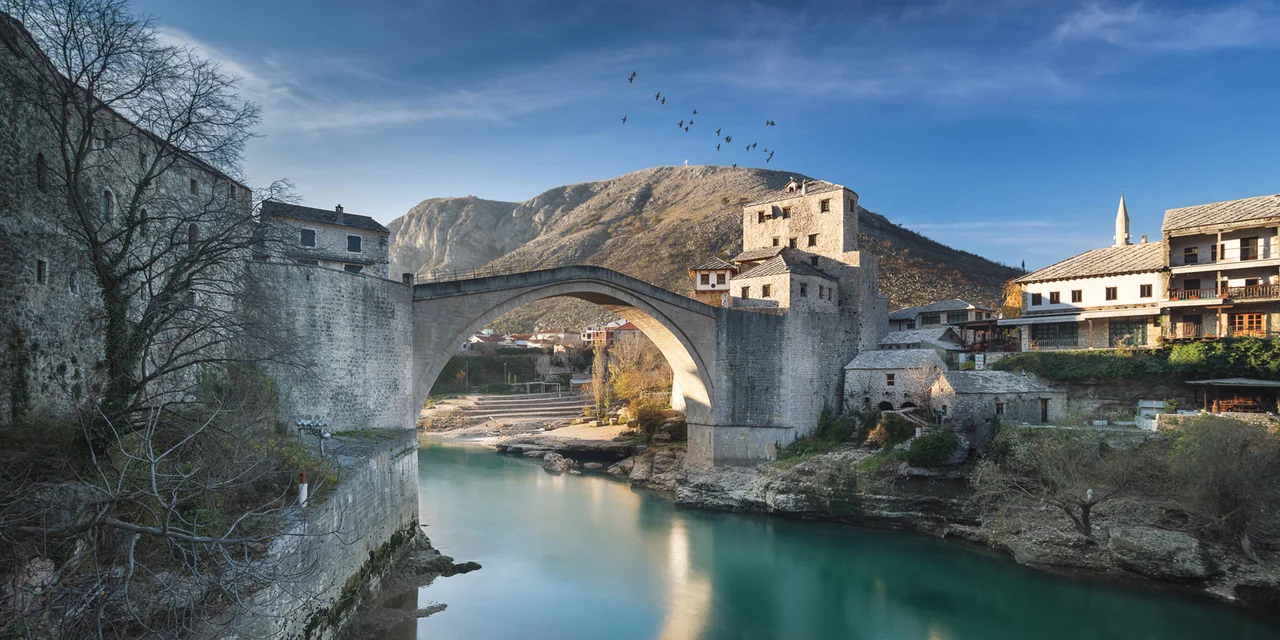
Mostar
The art of living in contradiction
Mostar is a city that cannot be understood from a single perspective. It does not open easily, nor does it allow simple interpretations. Set in the narrow valley of the Neretva River, between Herzegovina’s karst terrain and surrounding mountain massifs, Mostar has for centuries lived in tension between opposites: East and West, stone and water, humor and tragedy, everyday life and symbolism.
Unlike cities that grew through expansion, Mostar developed vertically-along the river, against rock, around bridges. Space was always limited, and it is precisely this limitation that created intensity. Everything happens close together here: people, stories, collisions, encounters. Mostar is a city of concentration.
The Neretva is its axis. Cold, fast, and emerald green, it does not merely divide the city-it defines it. Without the Neretva there is no Mostar, just as without Mostar there is no symbolic meaning of the Neretva. The river is boundary and connection, danger and refuge, daily reality and metaphor.

UNESCO in Mostar: the Old Bridge and the historic urban landscape
Mostar gained international recognition through the UNESCO World Heritage listing of the Old Bridge and the historic Old Town, inscribed in 2005. Yet the Old Bridge is not an isolated monument. It is part of a complex historical landscape that includes towers, the bazaar, mosques, houses, and streets shaped by Ottoman urban planning.
Built in the 16th century, the bridge was not only a technical marvel but a social gesture - connecting riverbanks, people, and lives. Its destruction in 1993 and reconstruction a decade later transformed it into one of the most powerful symbols of destruction and renewal in contemporary Europe. Here, UNESCO protects not only stone, but the idea of the city as a place of encounter.

The people of Mostar: humor as a survival mechanism
The people of Mostar are shaped by living close to everything. There is little distance here - spatial or emotional. From this emerges a distinctive mentality: quick, witty, often brutal, but rarely superficial.
Humor is the fundamental social currency of Mostar. It is a defense mechanism, a social corrective, and a form of art. Irony, sarcasm, and self-parody permeate everyday speech. Nothing is taken at face value here, least of all authority or self-importance. Those who cannot endure a joke often struggle to fit in.
Beneath that humor lies strong emotional intensity. People in Mostar feel deeply - love, loss, nostalgia, belonging. The city has produced poets, musicians, and artists precisely because emotions here have nowhere to escape.
Mostar does not produce calm people.
It produces expressive ones.
Cultural anchors and attractions
At the heart of the city lies the Old Bridge, together with the historic bazaar of Kujundžiluk, which still functions as a social space rather than a mere backdrop. The centuries-old tradition of Mostar bridge divers reminds us that the bridge has always been a place of courage, proving oneself, and belonging.
The Koski Mehmed Pasha Mosque, Karađoz Bey Mosque, and Čejvan-ćehajina Mosque together testify to the city’s Ottoman spiritual and urban heritage. Their courtyards, minarets, and interiors remain part of everyday life, not museum exhibits.
On the western side of the city stands the Croatian Home of Herceg Stjepan Kosača, a key contemporary cultural center hosting theatre, concerts, and exhibitions. Mostar has always been a city of art - from theatre and music to street performance and satire.
Rising above the city are Mount Velež and Fortica, natural viewpoints from which Mostar can be seen in its entirety. Only from above does it become clear how physically and symbolically compressed the city is between rock and river.
Mostar in two days
A city to be walked and listened to
Day One – The Old Town and water
Begin your day in the Old Town, early, before the crowds arrive. Cross the Old Bridge slowly and pause—not for a photograph, but for the sensation of height and the cold of the Neretva below.
Visit the Koski Mehmed Pasha Mosque and climb the minaret. The view from above offers the best sense of the city’s proportions. Walk through Kujundžiluk, but turn into side streets—this i where Mostar breathes normally.
For lunch, choose simple local cuisine. Food in Mostar is not experimental; it is direct.
Spend the afternoon by the Neretva or visit the Old Bridge Museum to understand the context of destruction and reconstruction. Evening is reserved for conversation, wine, and observation—Mostar relaxes at night.
Day Two – Beyond the postcard
On the second day, step outside the historic core. Visit Bišćević House or Muslibegović House to understand the private, domestic life of Ottoman-era Mostar.
Climb to Fortica or the slopes of Mount Velež. From above, Mostar ceases to be a myth and becomes a city—real, complex, beautiful, and fragile.
If time allows, continue on to Blagaj or Počitelj. Mostar is best understood within the context of its surroundings.
Why Mostar stays with you
Mostar offers:
- UNESCO heritage that is alive rather than sterile
- a city where humor is as essential as history
- people who speak quickly, feel intensely, and remember deeply
- a place where beauty and wounds are never separated


