A walk through history
Herzegovina
A Walk through history…
Herzegovina has a long and layered history in which different powers have come and gone, yet the continuity of everyday life and the character of its people has remained remarkably stable. As early as prehistory and antiquity, the area of today’s Herzegovina was inhabited by the Illyrians, most notably the Daorsi tribe in the Neretva Valley. Their main city, Daorson near Stolac, bears witness to a highly developed culture, trade and stone construction. Building with large, precisely fitted stone blocks speaks of durability, patience and respect for space. Life in a harsh karst landscape shaped people who were self-reliant, resilient and deeply connected to family and community-traits that can still be recognised in the Herzegovinian character today.
With the arrival of the Romans, Herzegovina became part of the wider Mediterranean world. Roads, bridges and urban centres were built, while viticulture and olive growing developed, especially in the valleys of the Neretva and Trebišnjica rivers. Traces of Roman order and infrastructure are still visible in the archaeological remains of Mogorjelo near Čapljina, where a Roman Villa rustica shows how life here was closely tied to nature, yet organised and functional. Rome brought structure, but it did not erase the local spirit-the relationship to land and family remained the foundation of daily life.
After the collapse of the Roman Empire and the arrival of the Slavs, an original medieval culture emerged, culminating in the phenomenon of the stećci, medieval tombstones unique to this region. The Slavs permanently arrived in the territory of present-day Herzegovina in the 7th century, following the weakening of Byzantine rule in the western Balkans. They came in several waves from the north (across Pannonia and the Sava River) and from the east (through the Danube valley), settling primarily in river valleys and fertile fields such as Livanjsko, Mostarsko, and Popovo Polje. They encountered remnants of the Romanized population and late antique settlements, many of which were abandoned or gradually Slavicized. Their arrival brought the Slavic language, a rural settlement pattern, and a stronger emphasis on pastoralism, laying the foundations for the later medieval society and cultural landscape of Herzegovina.
In the Middle Ages and especially later, this knowledge crystallised into the craft of the Ravno stonemasons. Builders from Ravno and Popovo Polje became known for their precise stonework and dry-stone construction, working throughout Herzegovina, Dalmatia and beyond. Their work was not merely a trade, but a way of thinking: to build slowly, accurately and durably, without excess material and without the need for ornament. This philosophy of building became deeply embedded in the Herzegovinian relationship with space-houses are built to last, walls to endure, and words to carry weight.
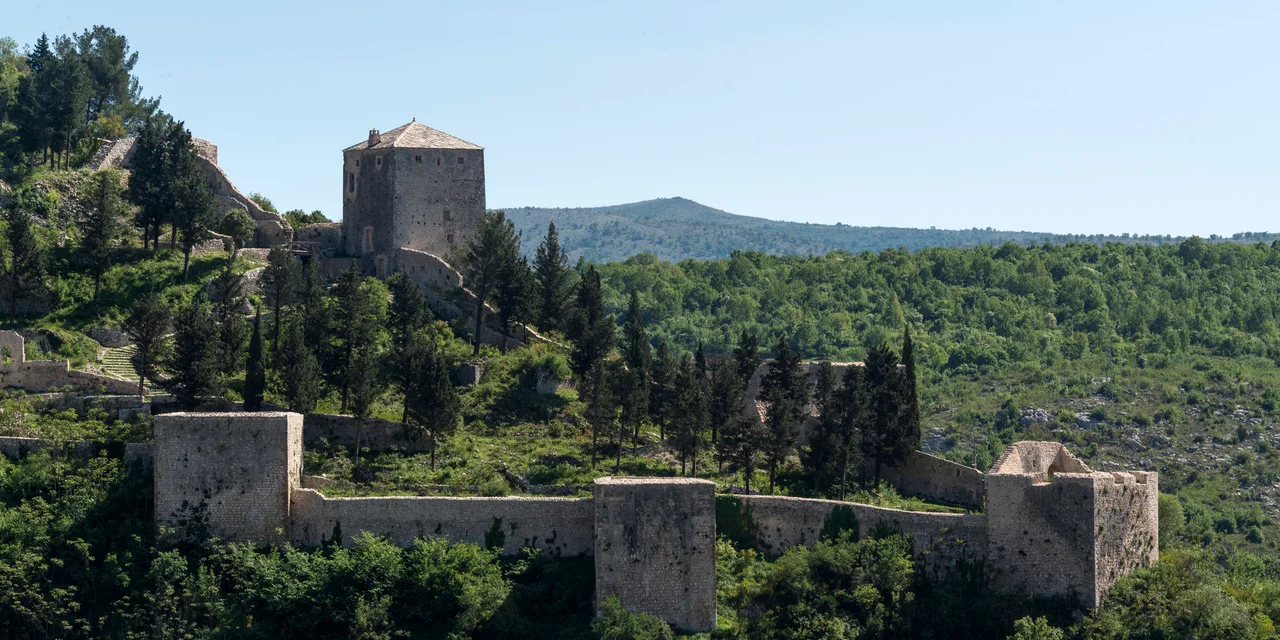
In the late Middle Ages, Herzegovina became associated with the powerful Kosača family. Fortified towns such as Stjepan-grad in Blagaj, hilltop fortresses overlooking the valleys testify to uncertain times and the need to control territory. The Kosača family was one of the most powerful noble families in medieval Bosnia and Herzegovina in the 14th and 15th centuries. The name “Herzegovina” derives from their rule, specifically from the title of Duke (Herceg) Stjepan Vukčić Kosača, who from 1448 held the title Herceg of Saint Sava and governed a territory stretching from the Neretva valley to the Adriatic coast. The Kosačas controlled key trade routes and strategic areas, built fortresses such as Blagaj and Počitelj, maintained complex relations with the Bosnian Kingdom, Dubrovnik, and the Ottomans, and significantly shaped the political and cultural history of southern Bosnia and Herzegovina in the late Middle Ages. People lived between mountains and fields, engaged in pastoralism, trade and viticulture, always ready to defend what was theirs. Character is marked by caution, resourcefulness and reliance on one’s own hands and knowledge became further entrenched.
With the arrival of the Ottoman Empire in the 15th century, Herzegovina acquired a new urban form. Towns descended into river valleys, and Mostar emerged as a true urban centre, with the Old Bridge as a symbol of connection between people, spaces and cultures. Bazaars, caravanserais and bridges changed the rhythm of life, while houses turned inward, towards courtyards and privacy. This Ottoman layer is clearly visible in Počitelj, a stone town perfectly integrated into the hillside, where the Illyrian-Roman legacy of stone meets Oriental urbanism.
At the end of the 19th century, Austro-Hungarian rule brought modern administration and infrastructure. Railways and new roads connected the interior with the coast, and in places such as Ravno and Zavala, railway stations and public buildings of clear lines and functional architecture were constructed. It is no coincidence that local craftsmen-among them the Ravno stonemasons-took part in these projects, combining traditional knowledge with new techniques.
In the 20th century, despite wars and political upheavals, the foundation remained the same. Houses continued to be built solidly, often by hand, and a sense of proportion and durability did not disappear. Today, this continuity can be seen in the stone villages of Popovo Polje, in dry-stone walls that still stand without mortar, in vineyards, and in people who continue to believe that everything of value is built slowly.
Throughout its history, Herzegovina was not shaped to please, but to endure, in and with her. That is why its character is best understood through stone-from the Illyrian walls of Daorson, through the stećci and the Ravno stonemasons, to the bridges and houses that still stand today as quiet witnesses of permanence.


