The Rumble of the Rails
The Rumble of the Rails
The train through Herzegovina mixes romance, history, and gorgeous landscape
By Peterjon Cresswell
Photos by JP Željeznice FBiH
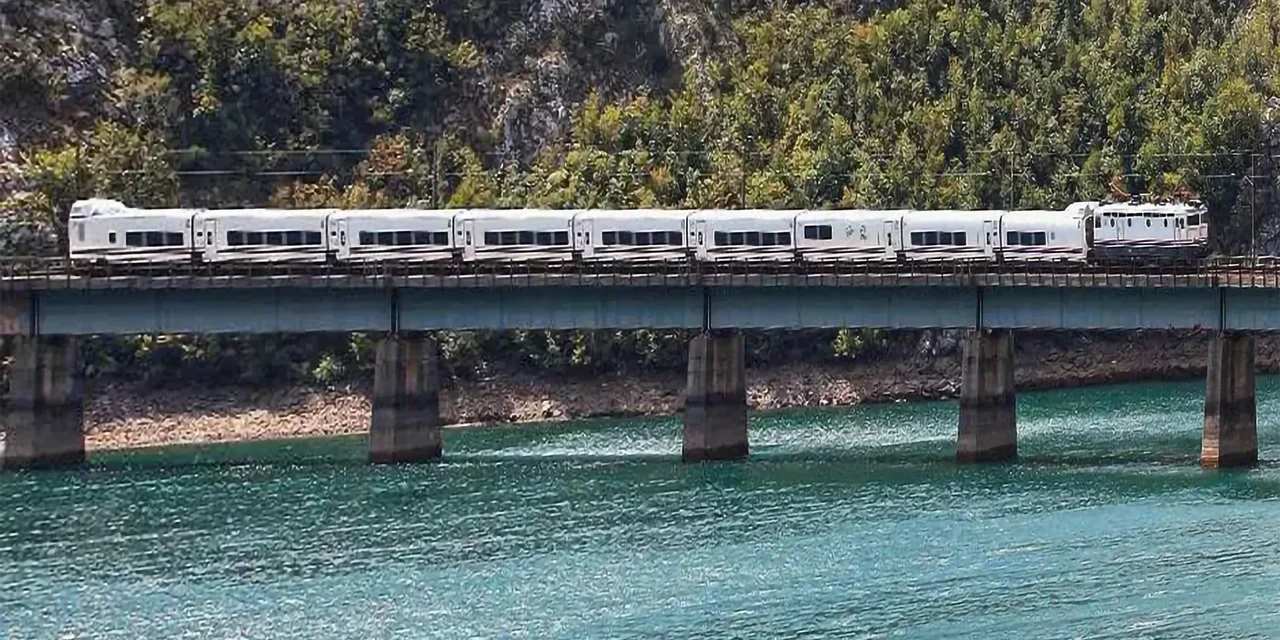
It takes exactly four hours to ride the twice-daily train from the heights of Sarajevo down to Croatia’s celebrated Adriatic coast. Four hours and 25KM enable you to gawk at the gorgeous landscape in modest comfort – most notably along the initial stretch towards the main stop of Mostar at the halfway point. If you’re lucky, you’ll be riding in Swedish-made carriages (look out for the signs inside saying “SJ”) from the 1970s, with their once-gorgeous wooden interiors, plush-if-scuffed upholstery and tip-back seats. Just pull back the broken lever and let Herzegovina unfold.

This being the Balkans, history is always underfoot. Although the Ottomans dreamed of a rail line that would link Vienna to Istanbul, the Habsburgs engineered the network in Herzegovina after they came to power in 1878. Setting to work almost immediately, a Directorate of Railways was established that September. A southern line to the coast was given priority. The first section, from the coastal gateway of Metković to Mostar, was opened in 1885. It was then extended to Ostrožac in 1888 and Konjic in 1889. The remaining 55 kilometers to Sarajevo proved a logistical conundrum for engineers, who devised a cogwheel mechanism to cover nearly 20 kilometers of steep gradient. It wasn’t until well into the 20th century that a further tunnel alleviated the track problem, and the line ran smoothly from the Bosnian capital to the coast.
This narrow-gauge line remained until Tito’s day. The Yugoslav leader loved the railway, traveling vast distances on his sumptuous Blue Train to meet heads of state. Modern-day tracks, such as the Ploče-to-Sarajevo one re-laid and opened in 1968, united Yugoslavia.
The bloody break-up of Yugoslavia took many of the railways with it. Slowly, rail links between these newly independent republics were restored, helping to reconnect and slowly heal at the same time. In August 2010, thousands gathered to greet a vintage steam train as it arrived to Višegrad in eastern Bosnia from Mokra Gora in Serbia … a much-loved service that connected Sarajevo, Belgrade, and Dubrovnik until 1974.
Today Dubrovnik has no rail link and Split has one main line to Zagreb; to reach either Dalmatian hub from Sarajevo by train, you must take the Ploče line then change onto a regular bus for the two-to-three hour journey in either direction. This, though, is little hardship. The morning train leaves Sarajevo’s once proud main station at six or seven in the morning, depending on the time of year. It allows the traveler time for a swift stubby brown bottle of Sarajevsko pivo (beer) in one of the little bars on the concourse. (If the Ploče service is 7am, make sure you don’t take the Budapest service leaving at the same time from the adjacent platform.) Don’t expect a dining car on board; a friendly Bosnian will come round with plastic cups of coffee and bottles of Löwe beer. He’ll accept Croatian kunas but KMs should elicit a smile.
Your approach to Mostar is dramatic: a panorama of mosques, markets, and bridges.
Again, depending on the time of year, you’ll either leave in darkness or daylight with the train clunking over points and maneuvering through the many tunnels and switchbacks that baffled the rail engineers of yesteryear. At the suburban stops of Hadžići, Pazarić, and Bradina, uniformed men in bright red hats appear from dilapidated station houses to signal a rare train. You’re now in open countryside, verdant slopes and clear streams encouraging you to bring out the camera.
The first major stop is Konjic, an hour and a quarter into the journey. This is the Upper Neretva. The waters are ice-cold and pure. This is an area of steep forests, glacial lakes, and trout farms. Konjic is also associated with some of the most notorious operations of the Bosnian war.
The train follows the pea-green Neretva due south all the way to Mostar – an hour more to go after passing Jablanica, which is famous for the bridge Tito’s Partisans blew up in 1943. It is still proudly sticking into the water. Your approach to Mostar, its station on the Bosniak east bank, is equally dramatic: a panorama of mosques, markets, and bridges overlooked by a vast crucifix installed by the Croats after the war. After a significant exchange of passengers, frustratingly, the tracks dive into a tunnel as you strain to make out the famed Stari Most or Old Bridge.
From here, the terrain becomes less rugged – arid in parts and dotted with vineyards and fig trees. By the time you pass Bačevići, Žitomislići, and Krućevići, 30 minutes from Mostar, you’re within easy reach of the religious site of Međugorje. Soon you’ll arrive at the border post of Čapljina. From here, you’re only 20 kilometers from the sea. A light passport check, a stamp (hoorah!), a change of engine, and you are shunted to Čapljina’s Croatian counterpart of Metković for more formalities and another stamp (hoorah, hoorah!).
By now the landscape has flattened out completely as you rustle through your luggage for swimwear and beach paraphernalia. Ploče, a rust-bucket transport hub, is not what you’re looking for, but a scheduled bus departing from right outside the station will take you to any beguiling Adriatic hotspot you fancy.


