Introduction
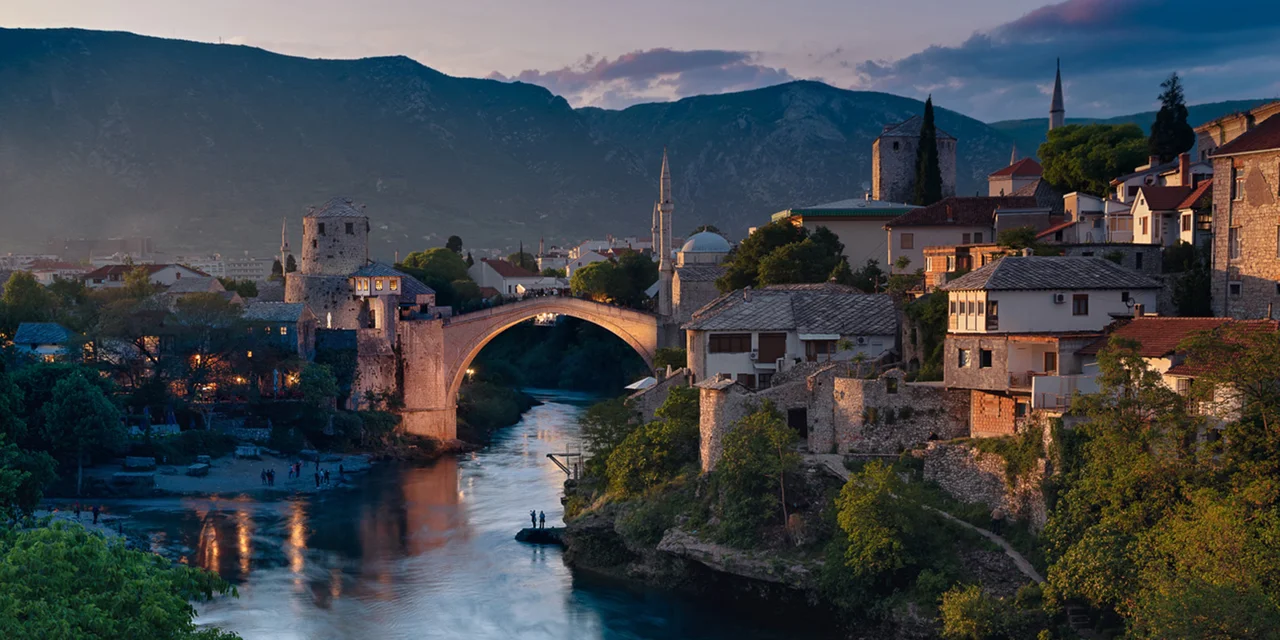
Mostar
Mostar makes you fall in love with it immediately. On first contact. You feel it before you understand it—through the light falling on stone, through the cold of its rivers, through the unhurried pace of people who, in truth, are never really late. This is a city where architecture is not scenery but an extension of life, and where space remembers more than it reveals.
The city grew out of stone. Literally. Houses, alleys, bridges, and courtyards are built from local stone that reflects the sun and changes colour throughout the day. Ottoman architecture—with its low houses, wooden bay windows, and enclosed courtyards—flows naturally into Austro-Hungarian buildings with straighter lines, taller façades, and pronounced details, all grounded in the quality of available material: Herzegovinian stone and the craft of old masters. The transition is never entirely smooth—but it is authentic. Mostar does not hide its layers; it lives them all at once.
Accommodation in Mostar reflects the city’s character: small boutique hotels and guesthouses in the old town offer atmosphere and proximity to the river, while more modern hotels provide comfort and views. Nowhere is there a sense of mass tourism—Mostar remains a city where you are a guest, not a passer-by.
Experiencing Mostar is not limited to sightseeing or walking across the sometimes-crowded bridge. The city reveals itself through walking, tasting, and lingering. Guided walking tours led by locals open up Mostar from the inside. The Spirit of Herzegovina allows visitors to taste the region through wine, conversation, and time that is not measured by the clock.
The dives from the Old Bridge remain a blend of tradition, performance, and survival. Jokes, flirting, and shouted banter are all part of the ritual, but when the moment of the jump arrives, Mostar turns serious. The water is cold. The height is real. After the applause—earned, not given—the process begins again.
The Bridges of Mostar
Mostar cannot be understood without its bridges. They are not merely crossings over the river, but landmarks, meeting points, and boundaries between the city’s different rhythms.
The Old Bridge, pedestrian-only and protected by UNESCO, is the city’s central point. Its elegant 16th-century arch, the work of master builder Mimar Hayruddin, has connected riverbanks and people for centuries. No one crosses it quickly—you stop, look down at the Neretva, and feel the city’s pulse. The dives and constant life on the bridge make it both a symbol and a living space.
Just beside the old core stands the Crooked Bridge (Kriva Ćuprija), smaller and quieter, built over the Radobolja River. Considered a precursor to the Old Bridge, its gently curved arch and intimate atmosphere make it one of the city’s most beautiful—and most overlooked—bridges.
The Lučki Bridge and Musala Bridge belong to everyday Mostar. These are bridges of movement, traffic, and routine—used to go to work, into town, and back home. From them, the Neretva is seen flowing through the city wide and serious, without ornament, as the city’s foundation.
The Customs Bridge (Carinski Most) recalls the Austro-Hungarian period and the city’s expansion beyond the old core. It marks the transition toward a more modern Mostar and a different urban rhythm.
Hasan Brkić Bridge (also known as Tito’s Bridge) is one of the city’s main arteries. Functional and solid, it connects the eastern and western sides of Mostar, showing the city as it truly lives—linked daily, without symbolism but with a clear purpose.
The Boulevard Bridge belongs to contemporary Mostar. Broad and direct in function, it connects newer neighbourhoods and confirms that the city continues to expand while remaining anchored to the river as its central axis.
The Mostar Character
Mostar—and its people—carry a particular, elusive mentality that cannot be learned, only absorbed slowly through streets, cafés, and conversations that seem to go nowhere yet say everything. Cynicism and dark humour here are not signs of coldness, but tools of survival. They are the city’s defensive language, shaped by repeated encounters with injustice, loss, and disappointment. A Mostarian will laugh where others would fall silent—not because they don’t care, but because they care too much. The humour is often rough, sometimes on the edge, but rarely malicious; it allows truth to be spoken without sentimentality and makes pain bearable.
The way people communicate further shapes this mentality. The Mostar dialect is soft and melodic, yet can become sharp in an instant. Sentences are often short, layered with subtext, leaving much unsaid—because it is assumed you will understand. Irony is not explained, emotions are not analysed aloud, but they are clearly felt. The speech feels casual, almost careless, yet beneath that ease lies the weight of experience and emotional depth.
In relationships, Mostar is equally direct and uncompromising. If you are accepted, you are accepted sincerely and for good. If you are not respected, no one will say it outright—but you will feel it. The city has little patience for pretence or empty words; authenticity is recognised quickly, and insincerity even faster. All of this makes Mostar a place that cannot be fully explained in words. Either you feel it, or you never truly know it.
There are also obligations in Mostar: to taste Herzegovinian wine, to sit for coffee without hurry, to eat smokvara, to walk a section of the Ćiro Trail, and at least once to stand still long enough to understand why the Bridge is more than a structure.
Mostar is a TERS — proudly grumpy, blunt, and impossible not to love.


