Mostar’s Muslibegović House and Museum
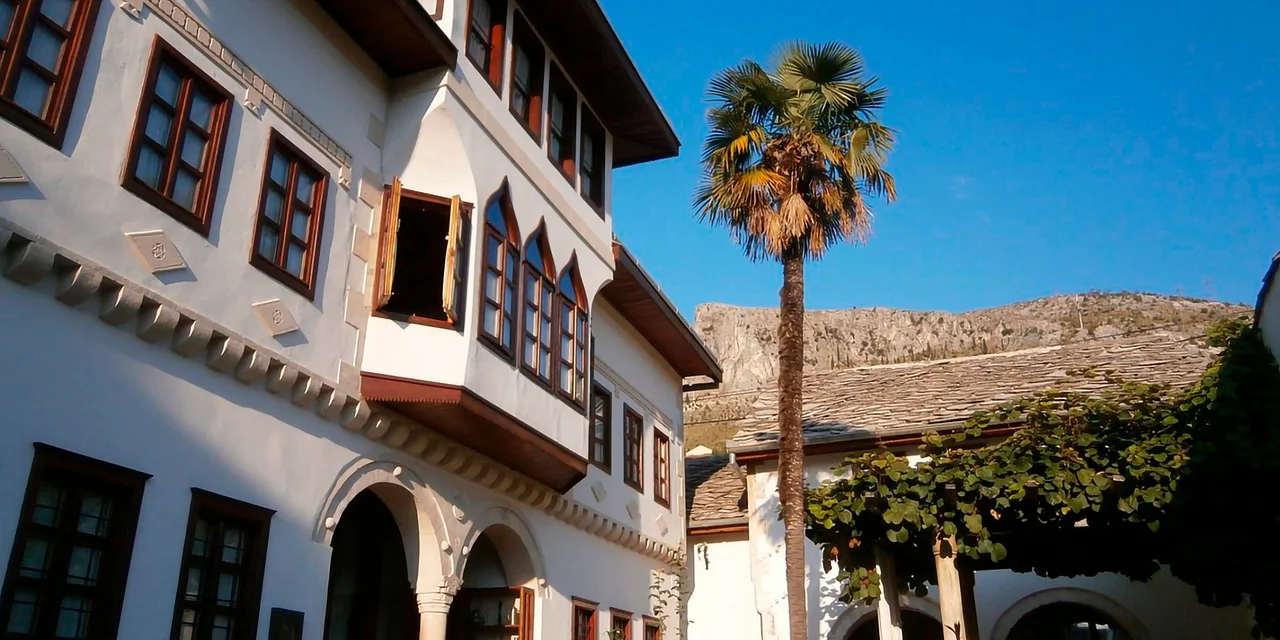
Mostar’s Muslibegović House and Museum
This national monument is a place to call home – if you are lucky … and fast
By Tony Dorsett
Walking up the small hill through the bullet-pocked neighborhood of Brankovac, one wouldn't expect to come across a glorious Ottoman estate. Although this part of Mostar took a heavy beating during the war that raged in the early 1990s, the Muslibegović House, a protected national monument, somehow avoided the devastation. Although the house did suffer some damage during the conflict, the most vital and valuable aspect of the house – its ancient contents – were spared. Heirlooms such as the intricately hand-carved interior, ancient documents, silverware, and even the bedding were all left intact.
Unlike most Ottoman estates in Bosnia and Herzegovina, the family decided to follow the Spanish model, opening the house as both a museum and a B&B. The attention paid to the restoration and customer service has been rewarded. Expedia Travel named the Muslibegović House one of the top ten accommodation locations in the world for 2010.
The ranking certainly came as a surprise to the owner and head of the household, Mr. Tadžudin Muslibegović. “I am still shocked. I know we have a beautiful home ... and we have tried to make this a special and intimate experience for our guests, but to be ranked eighth in the world by a survey of over one million people is beyond me.”
The family has a clear vision of how they do business. The rooms and atmosphere alone would charm any guest from any corner of the world. But they also go that extra mile to make one's stay as unique as the house itself.
During my visit, the museum curator and hostess, Sanela, darted from reception to the front door to talk with walk-in visitors. She then kicked off her shoes to enter the museum part of the house. She was giving a tour to two Australians, who, disappointedly, came too late to book a room. I tagged along.
Expedia Travel named the Muslibegovć House one of the top ten accommodation locations!
The house was built during the 17th century. The Star of David adorns its front. Sanela explained that within the Ottoman Empire, the symbol was widely used even amongst Muslims. We were obliged, as is Muslim custom, to remove our shoes before we entered. The front foyer has a modest dining set, with two mannequins wearing traditional attire sitting around a custom sinija round table. Our guide explained how most of the traditional outfits worn by Christians and Muslims during Ottoman times were largely the same. Each ethnic group, though, had their own specific color code.
We then walked up the creaky stairs. Each step whined with the tired oak boards. The central room, we learned, was where the men would meet for business and talking. The selamluk was generally off-limits for the women except when they came in to serve food and drinks or clean up afterwards. The ceilings were decorated with ornate woodcarvings and, as Sanela pointed out, each room had its own specific ceiling design. The room we stood in was decorated with writings and designs from famous Ottoman calligraphers.
Next door, in a traditional sleeping room, a sleeping mat, which would be rolled up and stored during the day, was covered with a silk and silver cover. The haremluk upstairs was, for me, the best room in the house. If the women got a bad deal with some of these traditions, at least they got the best room for natural light and for the once spectacular views. The 18th century room was cozy and colorful with a large bay window. In the old days, this position would provide a panorama of the entire city. Sanela informed us that even the Stari Most was visible from here. Today, the sightline is obstructed by unimpressive views of the local medical clinic and a modern house.
As the short tour ended and Sanela escorted the guests back down to the avlija, she signaled for me to follow. One of the hotel’s 12 rooms, the pasha suite, was free. The rooms are a perfect blend of modern amenities, all carefully decorated in Oriental style. They have authentic, handmade furnishings and beddings. Before I departed I put myself on the waiting list for a room. Now I am just waiting for the call.


