Blagaj
Blagaj (City of Mostar)
An oasis of water, faith, and layered continuity
Blagaj unfolds as an oasis of peace and natural harmony, shaped by water, stone, and centuries of cultural exchange. Located just 12 kilometres south of Mostar, at the meeting point of the Buna, Bunica, and Neretva river systems, Blagaj has long been a place where nature and human settlement coexist in a finely balanced relationship. Unlike destinations defined by a single monument, Blagaj is understood as a cultural landscape, where history, faith, and everyday life remain inseparable from the river.
The strategic and symbolic importance of Blagaj dates back to antiquity. Above the settlement rises Stari grad Blagaj (Herceg Stjepan Grad), one of the largest and best-preserved medieval fortresses in the region. Built on a dramatic limestone cliff, the fortress served as a stronghold of the Kosača noble family, rulers of medieval Hum (today’s Herzegovina), and is traditionally associated with Queen Katarina Kosača-Kotromanić. Its origins likely reach back to Illyrian times, while later Ottoman additions reinforced its defensive role. From its walls, the landscape opens toward the Buna valley and the wider Neretva basin, revealing the geographical logic behind Blagaj’s historical significance.
With the arrival of the Ottoman Empire in the 15th century, Blagaj gained new layers of meaning. The Sultan Suleiman (Careva) Mosque, more than 500 years old, stands as a reminder of Blagaj’s role as an important administrative and spiritual centre. The town’s long history of coexistence is still visible today through the active presence of three religious communities, represented by Islamic, Catholic, and Orthodox places of worship that shape the settlement’s visual and social fabric.
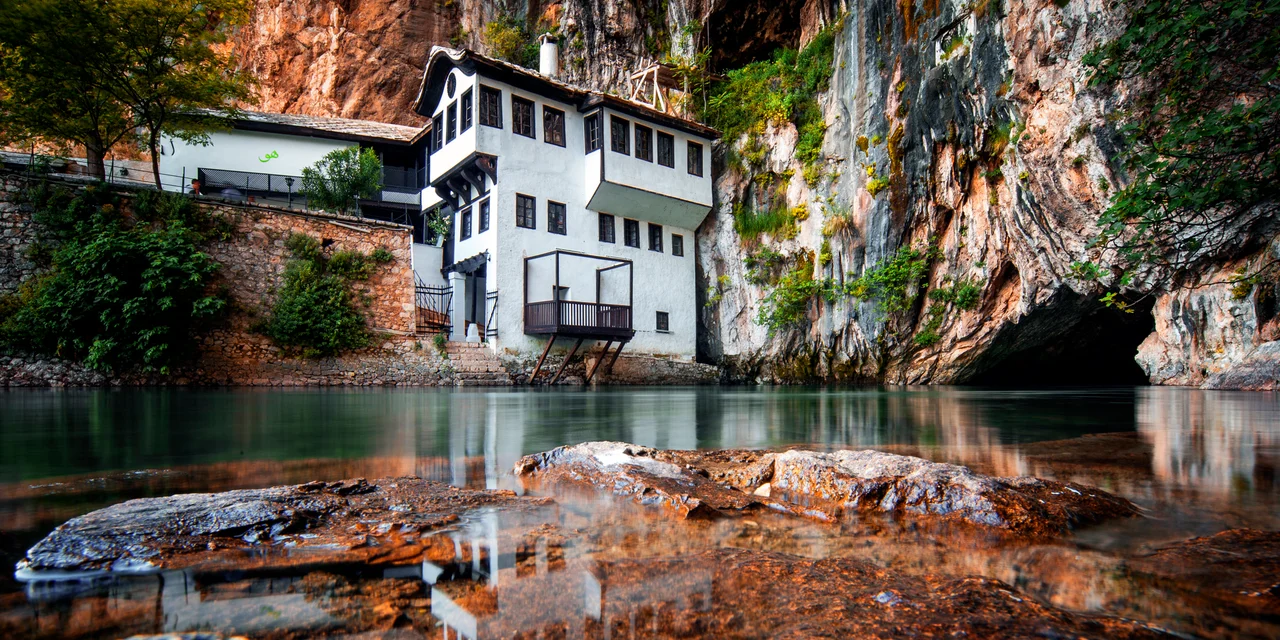
At the heart of Blagaj lies its defining natural phenomenon: the spring of the Buna River. Emerging beneath towering cliffs several hundred metres high, the Buna is among the largest karst springs of drinkable water in Europe, releasing tens of thousands of litres per minute. This dramatic emergence of water forms one of the most iconic natural scenes in Bosnia and Herzegovina. Nestled at the very source of the river is the Blagaj Tekke, a 16th-century dervish monastery and one of the most significant Islamic monuments in the country. Protected as a national monument, the tekke today functions as both a museum and a living cultural site, offering visitors insight into Sufi traditions, Ottoman architecture, and the spiritual dimension of the landscape.
Blagaj is also a place of remarkable biodiversity. The surrounding cliffs and river corridors provide habitat for around 170 bird species, while the mild Mediterranean-influenced climate supports the cultivation of strawberries, cherries, grapes, figs, peaches, apricots, pomegranates, and even kiwi. The cold, clear waters of the Buna—rarely exceeding 10°C—create ideal conditions for the farming of California trout, a local gastronomic speciality.
Daily life in Blagaj unfolds along the riverbanks. Traditional fish restaurants, shaded gardens, and riverside terraces offer a sensory experience where cuisine, landscape, and climate converge. Along the approach roads, small shops sell local products such as honey, jams, dried figs, and fresh seasonal fruit, reinforcing the connection between agriculture, craft, and tourism.
Cultural heritage in Blagaj extends beyond monumental architecture. The Velagić House (Velagićevina), an 18th-century Ottoman residential complex, offers insight into domestic life of a wealthy Muslim family. Carefully restored and partially converted into a guesthouse, it remains an example of how historic structures continue to serve contemporary purposes without losing authenticity.
Blagaj also engages actively with nature-based and recreational tourism. Canoeing and rafting on the Buna and Bunica rivers allow visitors to experience the landscape from water level, while cycling, hiking, and camping connect Blagaj with its wider hinterland. The nearby Eco Center, run by the youth organisation Novi Val, focuses on environmental protection and the reintroduction of griffon vultures, reinforcing Blagaj’s role in conservation and education.
Despite its popularity, Blagaj retains a measured, unhurried rhythm. The river dictates pace, the cliffs impose scale, and the layering of cultures encourages reflection rather than spectacle. Heritage here is not isolated behind barriers, but woven into daily life—prayed in, lived with, tasted, and crossed.
Blagaj does not rely on a single attraction.
Its strength lies in convergence: water and stone, nature and belief, history and hospitality.


