Bratač
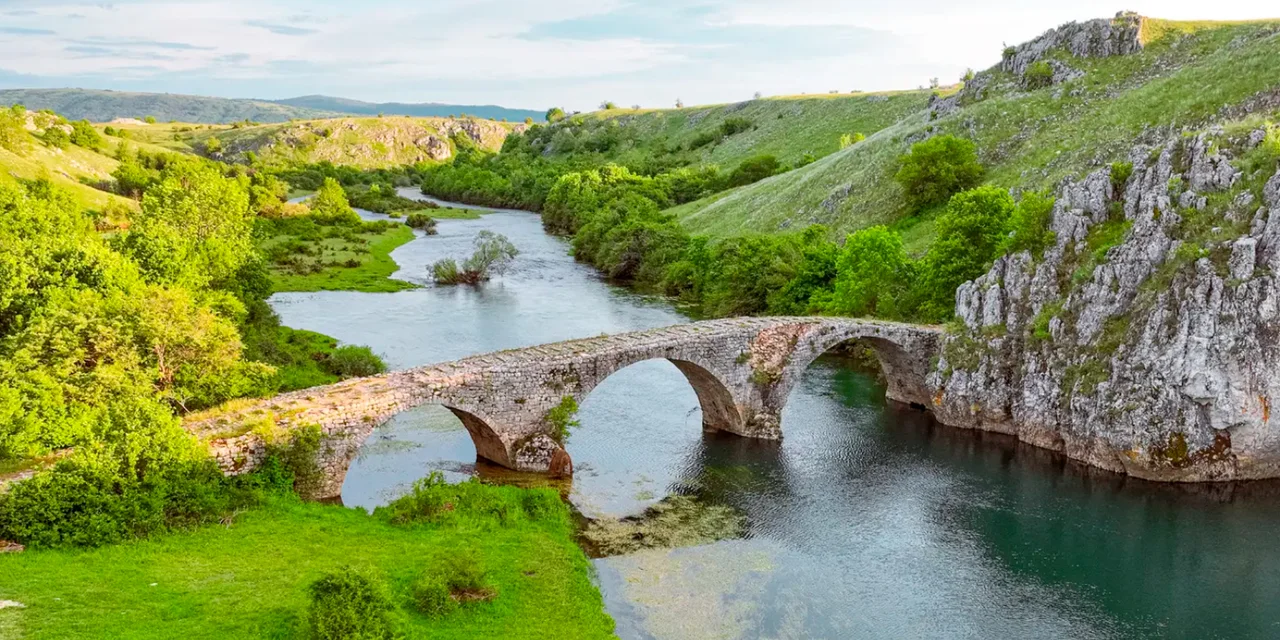
Bratač (Municipality of Nevesinje)
Stone memory, movement, and endurance on the Nevesinje Plateau
Bratač unfolds as a landscape of layered memory on the Nevesinje Plateau, a wide, elevated karst plain where history is not concentrated in a single landmark, but dispersed across terrain, paths, and stone structures shaped over millennia. Here, space itself is the archive. Roman roads, Illyrian burial sites, medieval bridges, dry-stone walls, and seasonal rituals coexist within a living rural landscape that continues to function much as it always has.
The defining feature of Bratač is the continuity of movement. This has long been a crossing point rather than a destination—a place shaped by transit, herding routes, and seasonal rhythms. Evidence of this reaches back to antiquity. Roman remains and a Roman road lead toward the medieval bridge known as Ovčiji Brod, suggesting that a crossing existed here even during the Roman period. The present bridge structure dates to the Ottoman era and spans the sinking river Zalomka, a classic karst ponornica. Ovčiji Brod is today protected as a National Monument of Bosnia and Herzegovina, not for monumentality, but for its role in sustaining movement, exchange, and everyday life.
Bratač is equally marked by prehistoric and early historic layers. Illyrian burial mounds, fortified hill settlements (gradine), and scattered remains of stone structures testify to organised life long before written history. Medieval stećci necropolises appear across the area, placed in open fields and gentle slopes rather than enclosed sacred grounds, reinforcing the sense that memory here is embedded in the landscape itself.
The built environment of Bratač reflects a deep understanding of karst conditions. Dry-stone walls, stone-built cisterns and spring captations, and carefully managed water systems reveal a culture that adapted to scarcity and seasonal change rather than attempting to overcome them. Particularly notable is the mill complex at Čečuge, complete with a dam and water channel (jaz), which illustrates how limited surface water was harnessed efficiently for grain milling—an essential function in a pastoral-agricultural economy.
Natural morphology is inseparable from cultural form. The area is rich in karst features—sinkholes, limestone formations, and subtle terrain variations that dictate land use, grazing patterns, and settlement placement. Rising above the surrounding fields is Bratački Gradac, a prominent elevation that likely served as a defensive or observational point, reinforcing the strategic importance of the plateau.
Despite its deep history, Bratač is not a static heritage site. It remains a living rural community, known today for the continued production of traditional foods: cheese aged in animal skin (sir iz mijeha), kajmak, and Nevesinje potatoes, products shaped by altitude, climate, and long-established pastoral practices.
Each August, Bratač becomes the ceremonial heart of the Nevesinje Olympics, a tradition more than 150 years old. On Bratački Lug, horse races and traditional chivalric games take place, transforming the landscape into a stage where strength, skill, and collective memory are enacted rather than exhibited. This event does not recreate tradition—it continues it.
Bratač does not present its heritage through interpretation panels or curated routes alone. Its value lies in the coherence of place: roads that still lead somewhere, bridges that still cross water, fields that are still worked, and rituals that still gather people together. Stone here is not decorative; it is structural, functional, and symbolic.
In this sense, Bratač represents a model of rural heritage where history remains active, landscape readable, and tradition embodied in daily practice. It is not a place designed for quick consumption, but one that reveals itself gradually—through walking old paths, reading stonework, and observing how life continues to move across the plateau.


