Ravno
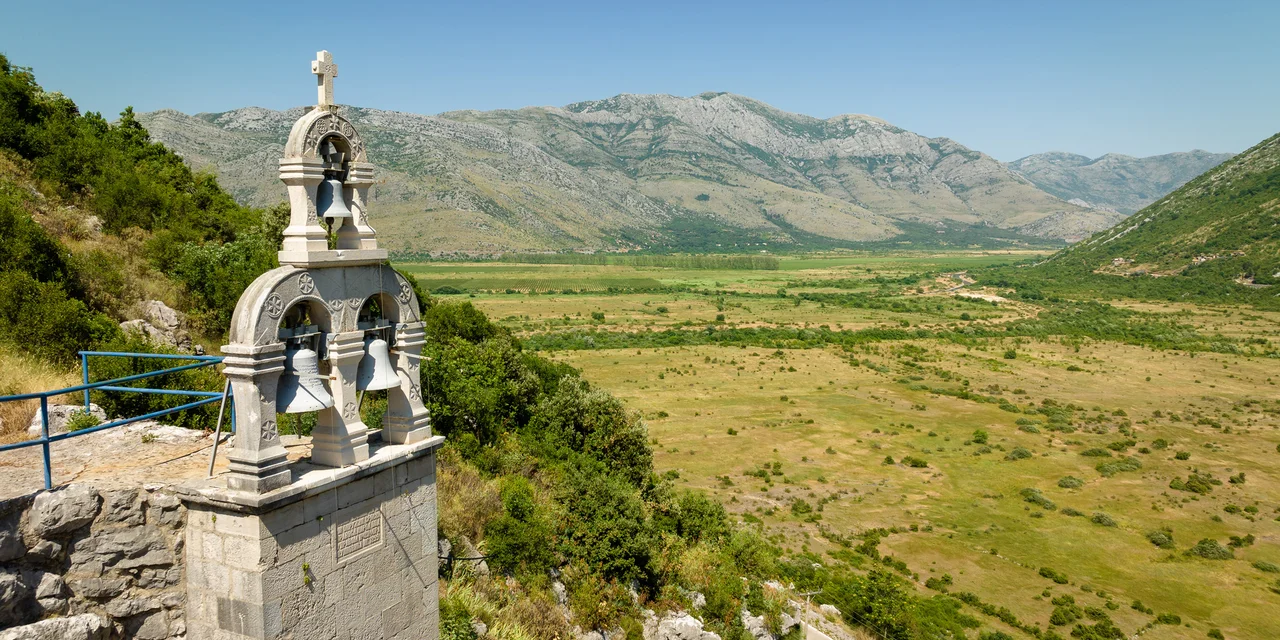
Ravno
A village shaped by stone and patience
Ravno stands out within the Best Tourism Villages nomination as a place where nature, history, and everyday life have remained in balance—quietly interconnected and deeply rooted in the landscape. Located in Popovo Polje, one of the most important karst regions in Southeast Europe, Ravno is not defined by a single monument, but by the integrity of space and a way of life shaped here over centuries.
The fundamental value of Ravno lies in its untouched nature, not as an empty backdrop, but as a system people have learned to live with. Karst has never been perceived as an obstacle here, but as the logic of the landscape itself. The sinking of water underground was not understood as a loss, but as an opportunity: the power of water was used to grind grain in technologically unique mills, while everyday life adapted to the seasonal rhythm of the Trebišnjica River. During periods of high water, locals fished gaovica using fine silk nets; when the river withdrew into its underground channels, the same land became fertile fields of legumes, grains, and fast-growing vegetables.
This ability to coexist with nature—rather than exhaust it—is one of the key reasons Ravno meets the criteria of the Best Tourism Villages initiative. This is not a place preserved as a museum exhibit, but a living community: fields are cultivated, gardens remain active, and the rural structure continues to function. Stone architecture, dry-stone walls, farm buildings, and homes form a harmonious whole shaped by local materials and knowledge, without the need for staged tourism aesthetics.
The landscape of Ravno is further read through its sacral and archaeological layers. The Church of St. Mitar in Ravno, surrounded by old graves, testifies to a long continuity of life and faith. The church and cemetery are not isolated memorial sites, but part of a living space where past and present meet without rigid boundaries. A similar layered significance is carried by the Church of the Nativity of the Blessed Virgin Mary, which continues to serve as a spiritual and social centre of the community.
In nearby Zavala, the landscape gains additional depth. The Zavala Monastery, almost embedded into the rock itself, is a unique example of sacral architecture that does not dominate the landscape, but follows it. In its immediate vicinity lies the archaeological site Crkvina of St. Peter, confirming the long-standing continuity of religious life in this karst environment.
Above all, Ravno’s identity is strongly shaped by Vjetrenica Cave, situated within this same hydrogeological system. As a UNESCO-listed site and one of the most biologically diverse caves in the world, Vjetrenica is not merely a natural attraction, but a key to understanding the entire area. Underground flows, sinkholes, and complex karst processes shape both Popovo Polje and life within it, making hydrogeological phenomena a foundational element of Ravno’s identity.
The open landscape of Popovo Polje and the riverbed of the Trebišnjica allow this system to be experienced physically. In winter, the field transforms into a watery landscape; in summer, into fertile farmland—a variability that has for centuries determined the rhythm of life, agriculture, and movement. Traces of this movement remain visible today through a network of old paths, dry-stone walls, settlements, and prehistoric burial mounds, which testify to the earliest forms of organised life and ritual in this area.
A contemporary way of experiencing Ravno and its surroundings continues along the Ćiro Cycling Trail (Ćiro Trail), following the route of the former narrow-gauge railway. It is precisely on the most scenic and best-preserved section of this trail that Stanica Ravno is located—once an important transport and logistical hub, and today carefully restored and transformed into a boutique hotel. Set within the open landscape of Popovo Polje, Stanica Ravno symbolically connects industrial heritage, slow travel, and contemporary sustainable tourism. Staying here is not merely about accommodation, but about slowing down, embracing silence, and inhabiting a space read through horizon, light, and time.
All these elements—sacral buildings, archaeological sites, natural phenomena, routes of movement, and restored industrial heritage—do not function in Ravno as isolated attractions. Together, they form a network of experiences, a landscape not visited according to a checklist, but understood through presence, silence, and rhythm.
In this sense, Ravno truly embodies the idea of the Best Tourism Villages initiative:
- it does not seek spectacle, but integrity;
- it does not offer staging, but living tradition.
Ravno is not a place to be rushed through.
It is discovered slowly—through water that disappears and returns, through stone, silence, and people who know how to live with the landscape, not against it.


