Old Bridge
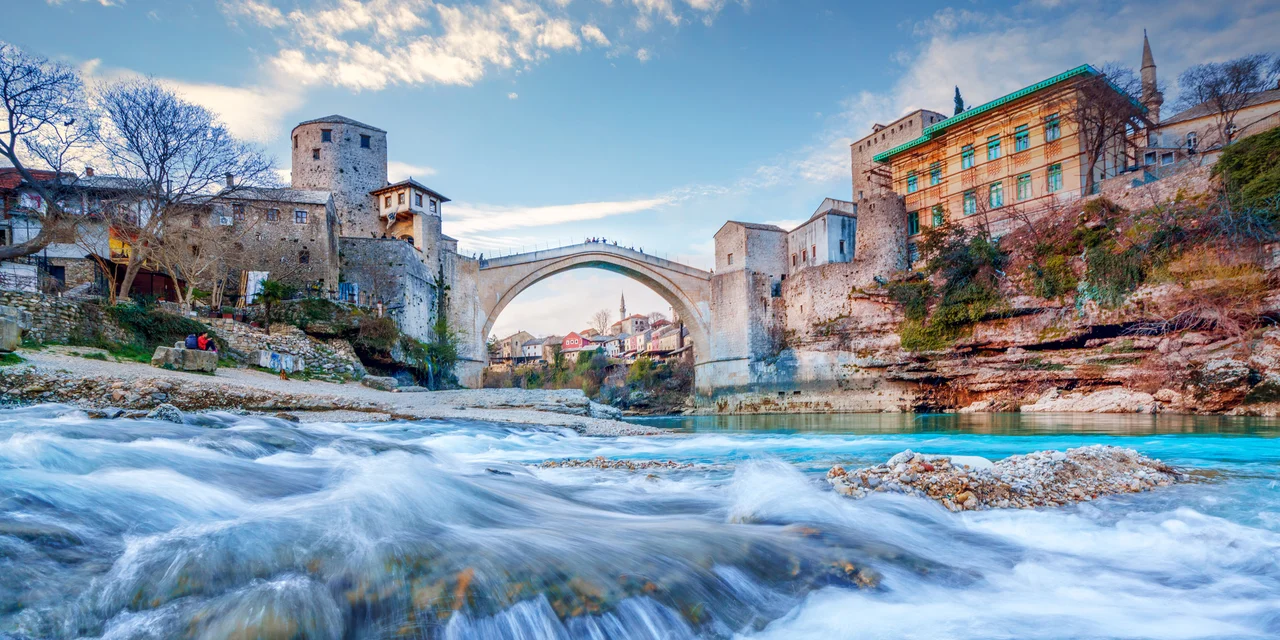
Stari Most
The symbol and the path
When people come to Mostar, almost everyone says the same thing: they didn’t expect the Old Bridge to affect them like this.
They first see it from a distance—perfectly arched, almost unreal, as if it doesn’t belong to this time. They take photos, draw closer, but the real moment happens only when they don’t rush. Those who pause—who simply stand and look before walking across—often say that this is when the bridge truly begins to work on them. The stone is smooth, worn down by centuries of footsteps, slippery underfoot, and the pace slows on its own. Some grip the railing, some smile, some fall silent. This is a bridge that asks to be approached with care.
On both sides of the bridge stand Tara and Halebija, stone towers that don’t feel like attractions but like quiet guardians. Tara, on the eastern side, once guarded weapons and the bridge itself; today it guards the story—housing a museum and offering a view from which Mostar feels composed and calm. Halebija, on the western side, more austere and enclosed, reminds us that the bridge was not only beauty but also boundary, watch, and responsibility. Walking between them means moving through a space where history is not explained—it is felt.
UNESCO sees its value precisely in this: the Old Bridge and the old urban core of Mostar are recognized as an outstanding example of a multicultural urban landscape, formed during the Ottoman period, where different worlds, faiths, and ways of life met for centuries. The bridge was not only an architectural marvel of the 16th century, but a real connection between riverbanks, people, and communities. Its destruction and reconstruction are today understood as a powerful symbol of resilience, reconciliation, and shared heritage.
Beneath the arch flows the Neretva—emerald, cold, swift. Visitors often say its color surprises them more than the height of the bridge. The river looks beautiful and dangerous at the same time, and the gaze is naturally drawn downward, as if pulled. When the divers appear, everything falls silent. There is no schedule, no announcement. Those who know, know it’s worth waiting. In the moment a body launches from the arch and disappears into the river, breath is held—then comes applause, not touristy but sincere. The dives from the Old Bridge are not a show; they are a Mostar ritual of which you are a witness, not an audience.
The story continues below the bridge. Boats and small craft glide along the river, passing just beneath the stone arch. From below, the bridge looks even stronger, almost impossible. In the river’s shade, with the sound of water and a view upward, the precision of the construction becomes clear, as does how perfectly it fits the landscape. Many only then grasp the bridge’s true scale—and why it’s worth experiencing it from below, not just crossing it.
Returning above, into the stone streets around the bridge and the Kujundžiluk bazaar, the rhythm changes again. Those who sit on a terrace—who seek not the best shot but the best view—often stay longer than planned. A glass of Herzegovinian wine—Žilavka or Blatina— arrives without hurry. It’s sipped slowly, with the sound of the river, the view of the arch, passersby, and divers preparing for another jump. In this blend of stone, water, and wine, the spirit of Herzegovina is felt—simple, strong, and real.
The Old Bridge is especially cherished by those who love authentic places, UNESCO heritage, architecture, photography—but also by those who seek not spectacle, but experience. Crowds are part of reality, especially in summer, yet even then a moment of quiet can always be found—early in the morning, late in the afternoon, or simply by pausing and letting people pass.
For some, the Old Bridge is romantic. For others, painful. For many, a symbol of hope. But almost no one remains indifferent. People leave with the feeling that they have touched something real—something not made for tourists, but born of the life of the city and still breathing within it.
And that is why the Old Bridge is remembered.
Not only for the image, but for the feeling that lingers long after Mostar disappears in the rearview mirror.
How to get the best experience of the Old Bridge
Choose the right time
Early morning (7–9 a.m.)
The quietest hours; the stone is cooler, the bridge dignified without noise.
Late afternoon / sunset
Warm light, tower shadows, the best atmosphere to sit and stay.
Avoid midday in summer—it’s hot, slippery, and crowded.
Don’t underestimate footwear
The stone is extremely smooth. Wear trainers or shoes with good grip. Elegant sandals and smooth soles often end in a “close encounter” with the stone.
Don’t cross right away
First stop, look, listen. The strongest impression comes before the first step.
If divers appear—wait. It’s worth every minute.
Experience the bridge from two perspectives
Above—walking between Tara (east) and Halebija (west).
Below—a short boat ride beneath the arch.
Only then do you truly understand the bridge’s scale and precision.
Include wine, but without haste
A glass of Žilavka or Blatina with a view of the bridge is not a luxury—it’s part of the experience. Sit facing the arch, not the screen.
Photography—less is more
The best photos aren’t taken from the bridge, but:
- from the riverbank below
- from the viewpoint by Tara Tower
- during the golden hour
Put the phone down for at least a few minutes.
Give yourself context
Before or after your visit, read a short account of the bridge’s destruction and reconstruction. The impression deepens, and the place gains gravity.
Respect the space
The Old Bridge is not a stage set.
Don’t climb where you shouldn’t, don’t run, don’t push.
If someone is standing and looking—let them.


