Radimlja
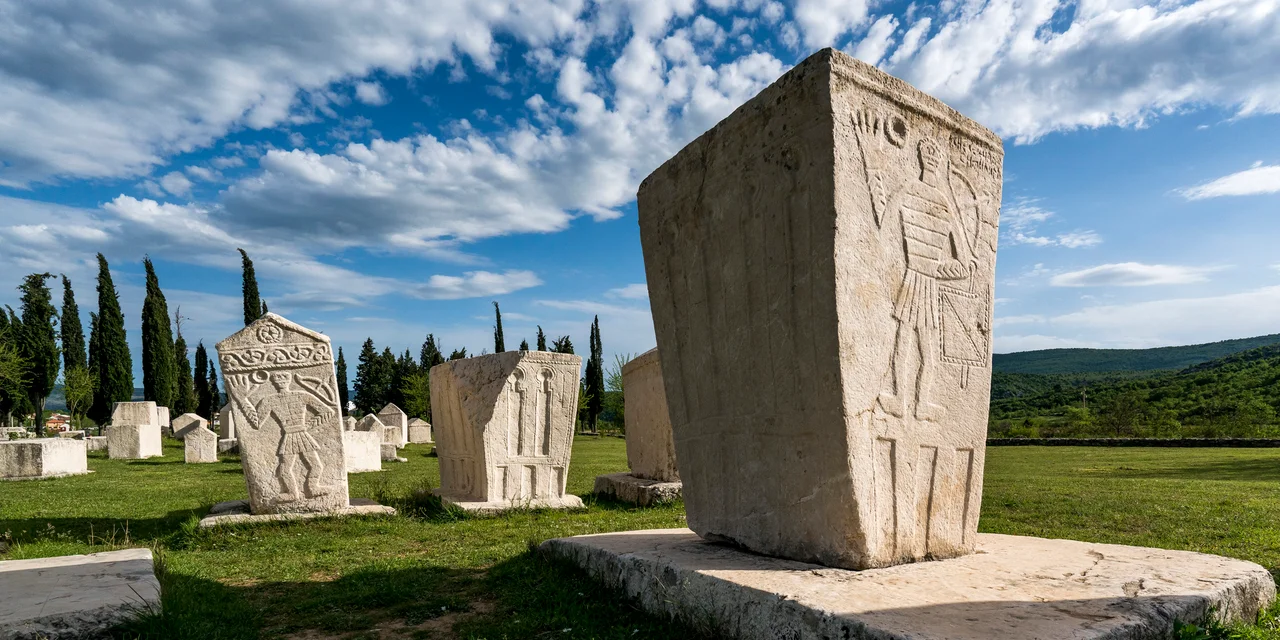
RADIMLJA – STEĆCI (UNESCO)
Mystic past welcome
Stećci are medieval stone tombstones, created between the 12th and 16th centuries, unique to the territory of present-day Bosnia and Herzegovina and parts of Croatia, Serbia, and Montenegro. They do not belong to a single nation, a single faith, or a single artistic style—this layered identity is precisely what makes them exceptional. They are quiet records of people who lived at a crossroads of worlds, in a space where East and West, different religions, languages, and ways of life met for centuries.
What makes stećci especially compelling for travelers is not only their age or number, but the way they communicate. Their reliefs do not follow strict rules of ecclesiastical art: figures with raised hands, hunting scenes, dancing, horsemen, spirals, and plant motifs. These are scenes of life, movement, and identity, carved into stone without the need to be fully explained. Stećci do not offer clear messages—they leave room for interpretation.
When people arrive at Radimlja, they rarely speak right away. There is no initial “wow,” no instant fascination. Instead, a silence settles in—not an uncomfortable one, but an invitation to slow down. The necropolis does not reveal itself from a distance; the stećci appear one by one as you walk through the open landscape above Stolac. There is no monumental entrance, no clear boundary between the “site” and the space around it. Radimlja stands open and understated, as if it does not ask for attention, but for presence.
The stećci are arranged along a gentle slope, in dialogue with the surrounding hills and a sky that feels wider than elsewhere. The stone is light, polished by time, yet not cold. Some monuments are massive and heavy, others modest, but all seem to stand exactly where they belong. Visitors are often surprised by the sense of order—despite the absence of strict geometry, the entire space feels balanced and calm.
The reliefs do not reveal themselves all at once. You have to come closer. Figures with raised arms, hunters, horsemen, crosses, spirals, and plant motifs slowly emerge from the stone. From a scholarly perspective, stećci testify to the distinct cultural and spiritual identity of medieval Bosnia—different from both Western European and Byzantine traditions. Radimlja is one of the most representative necropolises, with more than a hundred preserved monuments, including slabs, chests, and gabled tombstones.
Particularly notable are the stećci associated with the noble Miloradović–Stjepanović family, whose names, symbols, and inscriptions can be traced across generations. These rare inscriptions speak not only of death, but of life, honor, land, and belonging. Because of this richness of meaning, Radimlja is essential for understanding medieval Herzegovina.
In 2016, UNESCO inscribed stećci on the World Heritage List under the title Stećci – Medieval Tombstone Graveyards, as a serial property comprising 28 necropolises in Bosnia and Herzegovina, Croatia, Serbia, and Montenegro. Within this framework, Radimlja was recognized as one of the most important sites due to its exceptional preservation, richness of reliefs, and strong integration with the natural landscape. UNESCO’s justification emphasized that the value of stećci lies precisely in the relationship between stone, space, and environment—a relationship that is felt most clearly at Radimlja.
But Radimlja is not experienced only through scholarship. In local folklore, stećci are known as “stone sleepers,” the work of giants or silent guardians of the past. It was believed they should not be touched, moved, or used as benches, because they remember. That sense of reverence is still present today—not as superstition, but as an instinctive respect for the place.
Radimlja especially attracts those who are drawn to quiet places: historians, archaeologists, photographers, writers, as well as travelers who do not seek explanations at every step. People move more slowly here, often returning to the same stone, viewing it from different angles, trying to understand something that cannot be fully translated.
The most beautiful time to visit is early morning or late afternoon, when light slides across the reliefs and shadows deepen their forms. At that moment, the entire space takes on an almost meditative quality. In summer, the sun can be intense, making water and sun protection essential, but even then Radimlja does not lose the calm that defines it.
Radimlja is not remembered for a single image.
It is remembered for the feeling of having stood among people who lived differently, yet were not distant. For the silence that remains as you return toward Stolac. For the realization that some places do not ask to be understood, but to be respected.
And that is why Radimlja endures.
Not as an attraction, but as an encounter with time that still speaks—quietly, but clearly.
Radimlja is not difficult to visit, but it does require a degree of care and awareness of the space.
Arrive without rushing.
Radimlja is not a place to be “done” quickly. Plan at least 30–45 minutes, and more if you enjoy photography or wandering without a fixed goal.
Choose your time of day carefully
Early morning and late afternoon offer the most beautiful light and the quietest atmosphere. At midday—especially in summer—the sun is strong and the experience can feel harsher.
Footwear matters
The terrain is natural—grass, earth, stone. Comfortable trainers or light hiking shoes are the best choice. Avoid thin-soled sandals.
Sun protection is essential
There is little shade at the necropolis. A hat, water, and sun protection are not optional, especially from May to September.
Respect the stećci
Do not climb on them, sit on them, or touch the reliefs. The stone may look solid, but it is fragile, and the place demands dignity.
Photograph slowly
The best photographs come when you don’t rush. Change angles, lower your viewpoint, let shadows appear. During the golden hour, reliefs seem to rise out of the stone.
Connect it with the surroundings
Radimlja makes the most sense when combined with a visit to Stolac, a walk along the Bregava River, or time spent in the old town. It is not an isolated point, but part of a wider story.
Arrive informed, but not overloaded
A short read about stećci before your visit deepens the experience, but don’t try to “understand everything.” Radimlja is felt more than it is explained.


