The Beans of Change
The Beans of Change
How a legume went from survival food to Slow Food
By Slobodan Vulešević
If you find yourself deep in Herzegovina – near Trebinje – and hungry, be prepared for a different kind of replenishment. Don’t expect pizza or steak. As you tuck your napkin under your chin, you may be surprised with a bowl of poljak beans. You may also be lucky enough to receive a tumbler of homemade grappa, or loza as it's known in these parts. Along with the beans you'll be served a wine you've never heard of before. It will be made of ancient regional grape varieties with strange names like Surac, Kadarun and Plavka. Sounds like a strange combination? Hardly. You are now living like a local. Like a Hercegovac.
This story is really about poljak beans and the philosophy of good, clean, and fair food. Some call it Slow Food: a movement founded in Bra, Italy, in 1986, by Italian gastronome Carlo Petrini. The main objectives are to promote local and traditional specialties and the advantages of simple living as a lifestyle.
Poljak beans were rediscovered in 2005. At that time one couldn't find more than couple of kilograms of this heirloom variety in all of Trebinje. No one could have known, then, that the beans would sustain the rural development of the entire community. It certainly didn’t cross any minds that it would be the foundation of a very active Slow Food convivium.
Today, the Runjevac household in Zgonjevo and the Vujović family in Laplja offer the beans as a gastronomic specialty. This was the start of Herzegovina's first Slow Food chapter. Jovo Runjevac and Đuro Vujović both admit that they were once the laughing-stock of their respective communities for attending meetings with the local NGO Centar za razvoj Hercegovine (The Herzegovina Center for Development), which promotes typical and traditional produce.
The reason for the skepticism is because the history of the poljak bean is rooted in poverty and the desperation of surviving in the rocky Herzegovina landscape. The locals couldn't see how their plight could fit with the exotic gastronomic philosophies from places like Tuscany, Istria, and regions of Spain. They couldn't visualize it because their grandmothers, who were forced to sweat over cauldrons, had told them how difficult it was to cook the bean. In these parts, though, no worldly experience can replace the ways of the forefathers. Things here are preserved and never forgotten.
The locals couldn't see how their plight could fit with the exotic gastronomic philosophies from places like Tuscany, Istria, and regions of Spain.
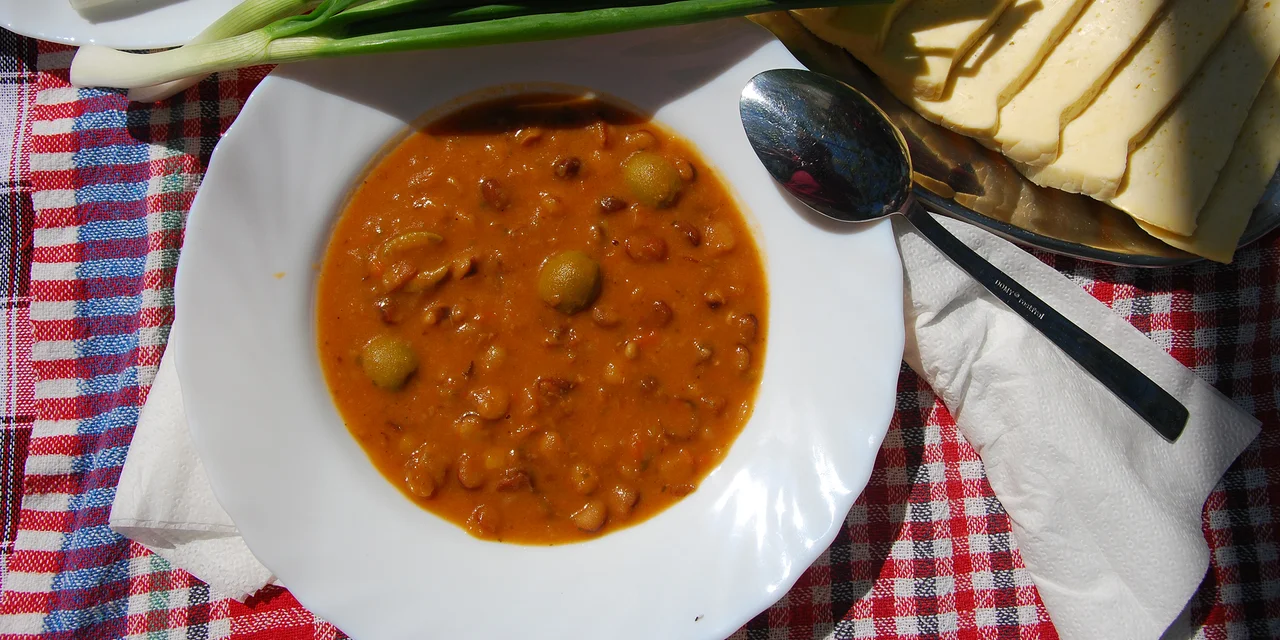
The beans are served in a huge pot placed at the table’s center. Before tasting can begin, however, one must pass the proper Herzegovina initiation: two glasses of cool loza. Why two? Well, custom dictates you start with as many legs as you walked in on. (After the loza is downed in one gulp – always one gulp – from a frosty glass, you might leave on all fours.) The next initiation phase is a visit to the host’s wine cellar for tasting. Next, a domaći paradajz jabučar (an apple tomato from their own garden) will be placed on the table along with sea salt and cow cheese made the day before. The cheese is called škripavac - or screecher – because of the sound it produces when eaten. While sitting on the terrace, under the shade of the vine leaves and unpicked clusters of grapes, the realization will strike that you are becoming a Hercegovac.
As you stretch out to reach the unusually meaty and red tomato, the hostess will suggest using coarse sea salt. Forget about high blood pressure and prepare for an explosion of taste. Next: homemade prosciutto, cut in long strips, best eaten with your fingers. The wine is offered at this time. But, it's best to wait until the loza has found equilibrium with our leading character – the poljak beans.
Seeing the beans cooked in a stew doesn't seem like anything special. If the host were to show them to you raw, you'd think he was holding a handful of stones of all colors and shapes. Your first thought certainly wouldn’t be lunch. Once it's been tasted, though, you’ll know you have tasted Herzegovina. These beans grow on the stone. They need hardly any water and are picked early in the day while moist with the morning dew.
What you’ll realize, while the tastes – beans, loza, wine, prosciutto, cheese, tomato, salt – swirl in your mouth, is that time means little to both the beans and these people. The poljak is sown when its time comes and is harvested in the same way. Science has nothing to do with its cultivation. As with the locals and their traditions, it follows only the whims of nature.


